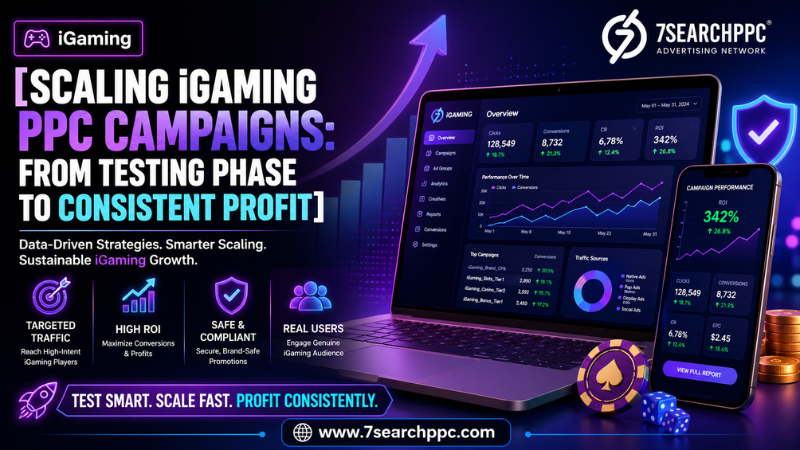
This transition—from controlled testing to real scale—is where most advertisers lose efficiency. Even in alternative traffic ecosystems, where platforms like iGaming PPC environments (such as 7SearchPPC) offer lower-cost entry points, the same pattern emerges: what works at $50/day rarely behaves the same at $500/day.
The real challenge isn’t launching campaigns. It’s engineering them to survive scale without breaking unit economics.
Scaling iGaming PPC campaigns successfully requires stabilizing conversion quality before increasing spend. Advertisers must validate deposit intent—not just registrations—ensure traffic sources align with funnel expectations, and gradually expand budgets while monitoring CPA volatility. Without filtering low-intent traffic and maintaining creative relevance, scaling typically amplifies inefficiencies rather than profits.
Why Testing Results Rarely Translate to Scale
During testing, campaigns operate in a controlled micro-environment. Limited impressions, smaller audience pools, and tighter delivery often mask inefficiencies.
Once budgets increase:
- Traffic sources expand into lower-quality inventory
- Audience intent becomes diluted
- Creative fatigue accelerates
- Auction pressure shifts cost dynamics
Advertisers often assume scaling is a linear extension of testing. It’s not. It’s a different phase with different variables.
In iGaming PPC campaigns, this becomes more pronounced due to bonus-driven traffic and mobile-heavy user behavior. At small scale, noise is manageable. At larger scale, it compounds.
Key Factors Behind Profitable Scaling
Sustainable scaling depends on three variables aligning simultaneously: traffic quality, funnel efficiency, and cost control. If any one of these degrades during expansion, profitability erodes quickly. Most campaigns fail not because of insufficient traffic, but because the system wasn’t designed to handle variability in user intent at higher volumes.
From Registration Volume to Deposit Quality
One of the most common scaling mistakes is optimizing for registrations instead of deposits.
At testing stage, registration cost (CPA) looks like a reliable KPI. But in iGaming, registrations are often inflated by:
- Bonus hunters
- Low-intent curiosity clicks
- Incentive-driven traffic spikes
When scaling begins, this imbalance becomes visible:
- Deposit rate drops
- Revenue per user declines
- ROAS becomes inconsistent
Advertisers who successfully scale shift optimization toward:
- First-time deposit (FTD) rate
- Deposit-to-registration ratio
- Post-click engagement behavior
This is especially critical in PPC for iGaming, where surface metrics often mislead early decisions.
Traffic Expansion Without Quality Collapse
Scaling inherently requires accessing more traffic. The problem is that additional traffic is rarely equivalent in quality.
In lower-cost environments—such as those accessed via platforms like 7SearchPPC—advertisers often benefit from early efficiency. However, as campaigns expand, inventory broadens into segments with weaker intent signals.
This creates a familiar pattern:
- Cheaper clicks → lower conversion quality
- Higher volume → inconsistent deposit behavior
- Broader targeting → weaker audience alignment
To counter this, experienced media buyers:
- Segment traffic sources aggressively
- Pause underperforming placements early
- Separate testing and scaling campaigns structurally
The goal is not just more traffic—it’s controlled expansion.
The Role of Ad Formats in Scaling Stability
Ad format selection becomes more important as campaigns scale. What works in one format may not translate across larger inventory pools.
For example, formats like iGaming push ads can deliver volume quickly, but often require stricter filtering to maintain deposit quality.
Similarly, pop traffic or native placements may behave differently depending on GEO and device distribution.
Advertisers working across multiple ad platforms often notice that scaling success depends less on format choice and more on:
- Audience-context alignment
- Creative-message consistency
- Post-click funnel clarity
The format itself is rarely the problem. Misalignment is.
Budget Scaling Logic: Gradual, Not Aggressive
One of the fastest ways to destabilize a profitable campaign is scaling too aggressively.
In most iGaming user acquisition PPC setups, increasing budgets by more than 20–30% at a time introduces volatility:
- Algorithms reset delivery patterns
- New traffic segments are introduced too quickly
- Performance data becomes inconsistent
A more stable approach includes:
- Incremental budget increases
- Parallel campaign duplication for scaling
- Controlled testing of new segments separately
This ensures that scaling does not disrupt the original performance baseline.
Creative Fatigue: The Hidden Scaling Killer
Creative performance often declines faster than advertisers anticipate.
At small scale, frequency is low and engagement stays high. But during scaling:
- Ad repetition increases
- User attention drops
- CTR declines
This directly impacts campaign efficiency. Lower CTR often leads to higher CPC and weaker funnel entry.
To maintain performance:
- Rotate creatives more frequently
- Test multiple messaging angles
- Adjust tone based on traffic source behavior
High converting iGaming ads are rarely static—they evolve with scale.
How to Scale Without Losing Profitability
To scale profitably, advertisers must prioritize deposit-focused optimization, expand traffic sources gradually, and continuously refresh creatives. Budget increases should be incremental, supported by segmented campaign structures. Most importantly, scaling decisions should be based on post-click performance metrics—not just front-end KPIs like CTR or CPC.
Platform Environment and Conversion Stability
Not all traffic environments behave the same under scale.
Some advertisers find stability by working with a conversion-focused iGaming ad network like 7SearchPPC, where inventory can be more flexible and cost-efficient compared to mainstream platforms.
However, flexibility comes with responsibility:
- Traffic must be filtered more actively
- Campaign structure must be tightly controlled
- Performance monitoring must be continuous
No platform guarantees scale. Execution determines outcomes.
What Advertisers Often Get Wrong
Across campaigns, a few recurring mistakes appear consistently:
- Scaling based on registration metrics instead of revenue
- Expanding targeting too quickly without segmentation
- Ignoring post-click funnel performance
- Underestimating creative fatigue
- Assuming low-cost traffic equals scalable traffic
These issues often remain hidden during testing and only become visible when budgets increase.
Balancing Volume and Conversion Quality
Scaling always introduces a trade-off: volume versus quality.
Higher traffic volume typically brings:
- Lower average intent
- More variability in user behavior
- Increased need for filtering
The goal is not to eliminate this trade-off, but to manage it intelligently.
Experienced advertisers focus on:
- Maintaining acceptable CPA thresholds
- Protecting deposit conversion rates
- Monitoring ROI consistency across segments
This is where trackable ROI iGaming campaigns become essential—not just for reporting, but for decision-making.
Frequently Asked Questions (FAQs)
How long should the testing phase last before scaling?
Ans. Testing should continue until consistent deposit data is available, not just registrations. In most cases, this requires enough volume to validate conversion patterns across different traffic segments.
Is low CPC always better for scaling?
Ans. Not necessarily. Lower CPC often correlates with lower intent. Sustainable scaling depends more on conversion quality than click cost alone.
What’s the safest way to increase budgets?
Ans. Incremental increases combined with campaign duplication tend to produce more stable results than aggressive budget jumps.
Do all ad formats scale equally?
Ans. No. Some formats scale faster but require stricter filtering. Performance depends on how well the format aligns with user intent and funnel structure.
Can scaling work without changing creatives?
Ans. Rarely. Creative fatigue accelerates during scaling, making ongoing testing and refresh cycles essential for maintaining performance.